
Why React Developers Can't Ignore OpenHarmony Anymore with emergence of React Foundation for React Native framework
React Native revolution just got a massive new target platform — and it’s not iOS or Android. It is now expanding to HarmonyOS as a emerging global 3rd platform

The React Native revolution just got a massive new target platform — and it’s not iOS or Android. Global developers, especially those building with React or React Native, have a compelling reason to pay close attention to OpenHarmony right now in early 2026.
OpenHarmony — the open-source distributed operating system donated by Huawei to the OpenAtom Foundation — powers HarmonyOS NEXT versions of HarmonyOS 5 and current HarmonyOS 6, Huawei’s fully independent (no Android compatibility) OS. It’s already running on tens of millions of devices in China, with over 10 million registered developers and more than 350,000 apps/meta-services in its ecosystem as of early 2026 with 47.2 million users as 1st of March 2026. The open-source base has surpassed 1.2 billion smart devices across scenarios (phones, tablets, IoT, wearables, automotive, PCs and more). But the real game-changer for international developers isn’t just the scale — it’s the strategic integration with the world’s dominant front-end framework.
The Power Move: Huawei + React Native + React Foundation
Huawei didn’t just build yet another OS. They partnered deeply with leading React Native experts at Software Mansion (a top-tier Polish firm behind libraries like Reanimated, Gesture Handler, and Screens) to create React Native OpenHarmony (RNOH). This library lets React Native apps run natively on OpenHarmony devices with minimal changes. Key libraries have been ported for smooth performance, and real-world apps (including major Chinese platforms like YY, Xiaohongshu, and Ctrip) are already adopting it.
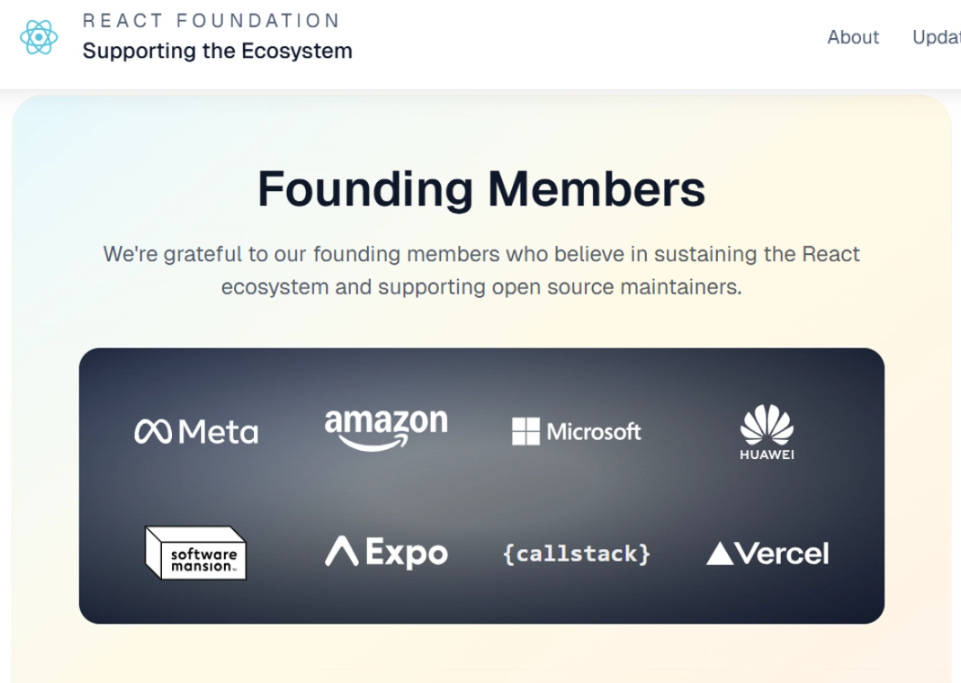
The collaboration started via projects like Oniro (Eclipse Foundation’s vendor-neutral OpenHarmony implementation) and escalated dramatically. On February 24, 2026, the Linux Foundation announced the formation of the React Foundation, with Meta donating React, React Native, and supporting components (like JSX) to neutral governance. The eight platinum founding members? Amazon, Callstack, Expo, Huawei, Meta, Microsoft, Software Mansion, and Vercel. Huawei explicitly stated their intent: to “deepen synergy” and “foster seamless and native interoperability between OpenHarmony and React technologies. ”This isn’t passive sponsorship, with Software Mansion already embedded from the RNOH work and now at the React Foundation table, Huawei secures influence over React’s future direction — ensuring OpenHarmony becomes a first-class citizen for React/React Native developers.
Why This Matters More Than Fragmented Linux Mobile Efforts
Traditional open-source mobile Linux projects (Jolla’s Sailfish OS, UBports’ Ubuntu Touch) struggled for years with tiny ecosystems, limited hardware support, and negligible app adoption. They lacked corporate scale, massive funding, and developer mindshare. OpenHarmony/HarmonyOS NEXT is different:
Industrial backing — Huawei invests heavily, ships billions of devices globally, and partners aggressively.
Massive momentum in China — Already the #2 mobile OS there (surpassing iOS in share at times), with plans for international expansion in 2026 (smartphones, tablets, PCs, wearables, cars, TVs, smart things etc.).
Distributed, multi-device architecture — Designed for seamless experiences across phones, IoT, cars, TVs — a true “all-scenario” OS where React Native’s cross-platform strengths shine.
Low-friction entry for devs — If you’re already using React Native, targeting OpenHarmony could mean code reuse with little extra effort. No need to learn entirely new stacks like ArkTS/Cangjie/ArkUI (though those remain options for native performance).
Huawei aims for global push in 2026, including potential stock HarmonyOS smartphones in markets like Europe among other parts of the world. The app gap is closing fast via tools like RNOH. Why Global Developers Should Pay Attention Now
Early-mover advantage — The ecosystem is young outside China. Being among the first to build/productionize React Native apps for OpenHarmony positions you as an expert in a rising platform with less competition.
Huge addressable market — Hundreds of millions (potentially billions) of devices long-term, especially in emerging markets and non-Google/Apple ecosystems.
Diversification beyond the duopoly — Android/iOS dominance is real, but geopolitical shifts, privacy concerns, and multi-device needs create openings for third paths. OpenHarmony offers one backed by real volume.
React ecosystem boost — With Huawei’s platinum role in the React Foundation, expect more official tools, docs, and community focus on OpenHarmony support — making it easier over time.
Innovation in distributed apps — Build once, deploy across form factors with native feel — a sweet spot for React Native devs eyeing IoT, wearables, or automotive.
The fragmented GNU/Linux mobile crowd couldn’t break through at scale. Huawei is taking a pragmatic, industry-backed approach — partnering with React giants to bootstrap adoption. If you’re a React/React Native developer, 2026 is the year to at least experiment: check out RNOH, explore DevEco Studio (Huawei’s IDE), and target OpenHarmony devices. The third major mobile/IoT platform might be arriving faster than expected — and React could be its on-ramp. What do you think — will OpenHarmony crack the global app developer barrier? Drop your thoughts below.